Astrology, Kriya Yoga, Dharma

Author and speaker Alan Watts was one of the early westerners to bring the spiritual teachings of the East to the West. Neither an academic nor a proponent of any particular path or order, Alan Watts was an Anglican minister with deep admiration of Buddhism, Taoism and Hinduism. He was a free thinker with an encyclopedic breadth of scholarship and a charming sense of humor.
A self-described "philosophical entertainer", Alan Watts was one of the few teachers who made it possible for westerners to accept and understand ideas which originated in India and Asia, free of sectarian influence. He steered clear of presenting himself as a guru, and emphasized the similarities of many spiritual traditions. He was perhaps most critical of his own lineage, but could illuminate its hidden doctrines with startling clarity.
I am the Lord, and there is no other.
I form the light and create evil.
I bring prosperity and create disaster.
I, the Lord, do all these things.
-- Isaiah 45:7
One of the most important by-products of the technological revolution of the 20th century, was effortless world travel and intellectual exchange: first by ship, later by airplane, and ultimately by instant electronics. This led to a collision of philosophical traditions. For the first time, in countries with freedom of speech, it became possible to review and evaluate thousands of years of religious thinking, spared from dogma or fear of persecution. Alan Watts was a significant participant in this process.

We could call Alan Watts a double Sagittarius, because both the Sun and the chart lord (the ruler of the 1st House) are in that constellation. Sagittarius and its ruler Jupiter have long been associated with seekers, teachers, and travelers. Alan Watts travelled the world and contacted other teachers and teachings.
"Mars in the sign of Sagittarius gives strong religious and philosophical convictions. People with this position are crusaders for the causes they espouse... These people like adventure and the excitement of distant places and travel. They seek to be leaders in law, religion, philosophy and higher education." -- The Astrologer's Handbook by Sakoian and Acker
As Sagittarius is the 9th sign and relates to all things expansive, so does the 9th house of the chart, and its lord. In this chart, the 9th lord is a bright Moon. When the Moon is bright, it functions as a strongly benefic influence, and this Moon is not only close to full, it receives the full aspect of Jupiter. These factors combine to further underscore his 9th house/Sagittarian/Jupiterian orientation.
Planets conjunct the North Node are amplified. Here we see Jupiter amplified by conjunction with Rahu within a few degrees. Alan Watts travelled widely, received his priestly ordination and ultimately settled in a foreign land. This horoscope does not disappoint: the birth data seems quite accurate.
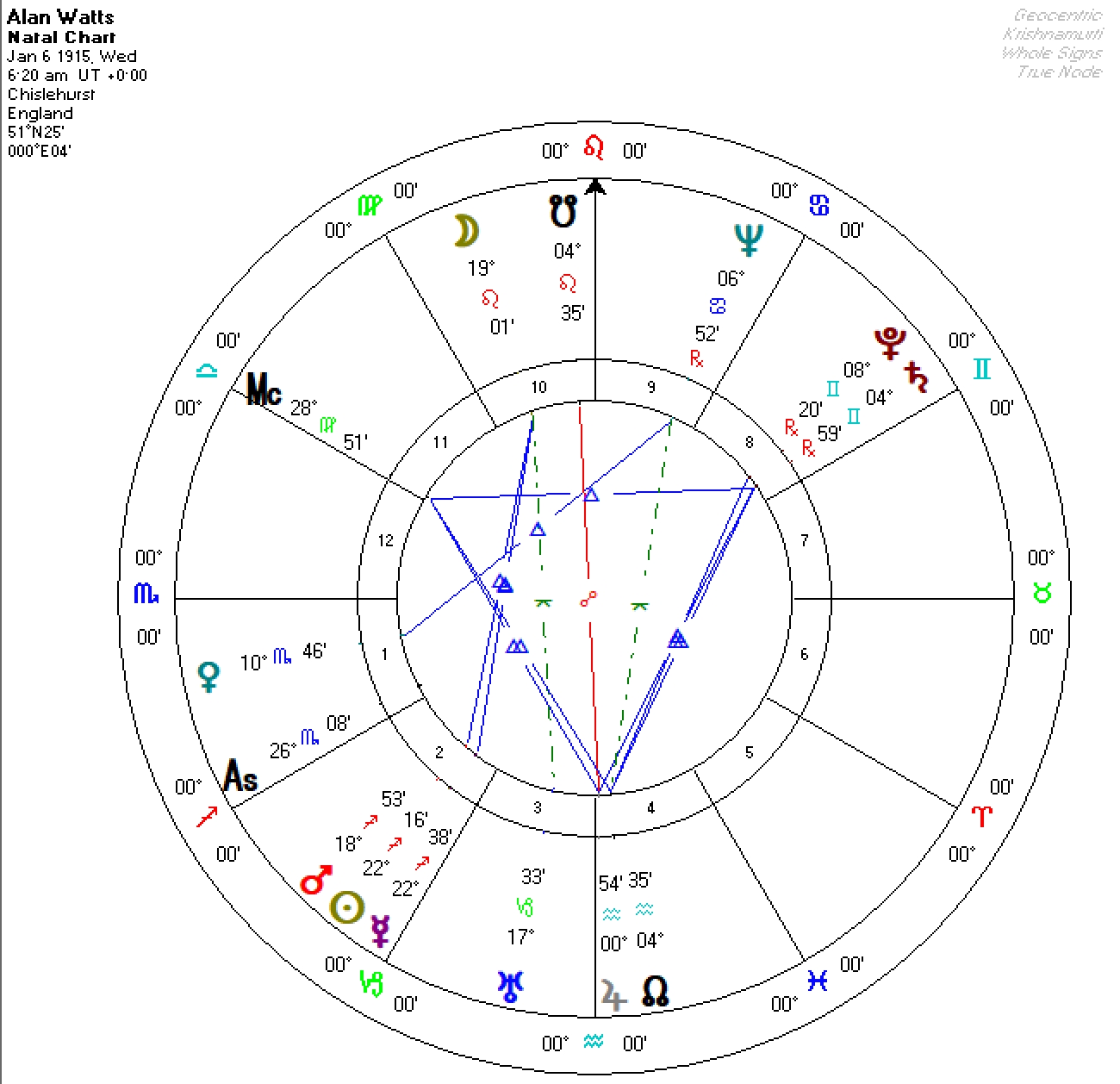
Whenever we find a pattern which occurs from the Ascendant, the Moon and the Sun's houses, the repetition suggests an important factor in the chart. This combination is called the Sudarshan Chakra or "best view wheel" in Indian astrology. Here, we observe that Alan Watts had the 12th lord in the 1st from all 3 points of reference. To describe this in modern terms, it's like having a very prominent 12th house, or 12th lord, or Neptune. As these symbols relate to inspiration, long-distance travel, religious orders, etc. this arrangement is yet another astrological indication of his keen interest in spirituality, commencing from an early age.
Finally, we come to the influence of Ketu in the chart. It combines with the Moon in the career house. Modern astrologers consider Ketu to be like Neptune: other-worldly, transpersonal, mystical. When it combines with the Moon in the house of profession, we get yet another indication of spiritual or religious calling.
 One of the most remarkable
features of his horoscope is the Second House, the house which deals with the
face, the mouth, and with speaking. It also deals with eating, drinking and smoking. His 2nd house contains
a conflicting mixture of influences.
One of the most remarkable
features of his horoscope is the Second House, the house which deals with the
face, the mouth, and with speaking. It also deals with eating, drinking and smoking. His 2nd house contains
a conflicting mixture of influences.
On the one hand, we see a favorable 2nd house because it contains a conjunction of Mars and Sun, the rulers of the auspicious 1st and 10th houses. This forms a natural Raja Yoga, a "royal combination" which promises success and recognition through 2nd house affairs. Mercury, as 11th Lord in the 2nd house, forms a natural combination for wealth. Alan Watts earned his income and fame through Mercurial means, as an author and lecturer. He wrote 28 books and appeared before audiences, conducted seminars and hosted a regular radio program.
Jupiter, the planet which rules his 2nd house, is conjunct Rahu, the North Node. Planets contacted by the North Node are magnified. This provides further evidence of his prodigious talent: Alan Watts was a spectacular public speaker.
On the other hand, we notice that the 2nd house contains the same Mercury, lord of the 8th house Gemini. As the 8th house relates to death, accidents and mishaps, we can view Mercury as a malefic influence. Or rather, we can view it as a natural benefic which simultaneously carries malefic influence. Such is Astrology.
Furthermore, the second house contains 2 naturally malefic planets (Mars and Sun) and a Mercury that has become "accidentally" malefic by its rulership of the 8th house: that makes 3 malefic influences. The ruler of the 2nd house, Jupiter, is in a weak degree. That makes 4 malefic influences. Whenever a house contains an abundance of malefic influences, there the native requires struggle and initiative to overcome the challenges of life. So while Alan Watts' 2nd house may have granted abundant worldly success through its "royal combinations", it did not promise an easy lifetime... or a long one.

All things being equal (they rarely are) we can evaluate the longevity of the native by the strength of the 1st and 8th houses. Here, we note that Alan Watts died at age 58, which by modern standards is fairly young. The circumstances of his death remain murky, but apparently he took his own life, after 6 months of careful premeditation and planning. He had been under treatment for a heart condition. Given the abundance of negative factors in his second house - and his life-long habit of generous alcohol and tobacco consumption - such an early demise was less surprising.
In charts with Scorpio rising, we can look to Pluto for clues about lifespan, and here we find it conjunct malefic Saturn, in the malefic 8th House. Those same two planets, Saturn and Pluto, although trined by benefic Jupiter, are opposed by malefic Mars and Sun. While the Jupiter aspect is favorable, the preponderance of influences is... unfavorable. Alan Watts died at the time of his second Saturn return, when transiting Saturn came back to its natal position next to Pluto in the 8th house. Transiting Ketu was passing over his Saturn at the same time. When a person experiences this many 8th house influences, it is time for a big transformation. In this case, the change was to exit the stage of life.
Others who died due to injudicious consumption include Elvis Presley (drug overdose) and and King George VI (smoking). Like Alan Watts, their charts contain a Mercury and 2nd house that were simultaneously powerful and afflicted.
One of Alan Watts' favorite lecture themes - a topic he often emphasized - he called the Dramatic Model of the Universe. He contrasted it to the Biblical model, wherein God fashioned the first man out of clay and blew into him the breath of life. He referred to the Biblical view as the Ceramic Model.
This will be the presiding image of Hinduism. Their idea is this: that God didn't make the world, like a technologist, but he acted it. That is to say every person - and every thing, for that matter - every tree, every flower, every animal, every star, every rock, every grain of dust, is a role or part which the Godhead is playing. -- "The Image of Man" by Alan Watts
 According to Watts, the basic Hindu model of the cosmos is that the Supreme Being engages in a process of acting out the entire
universe and everything in it, in an eternal
blissful play of creation, dissolution, and recreation, which he likened to the human cycles of dreaming and waking, inhalation and exhalation, apprehension and forgetfulness.
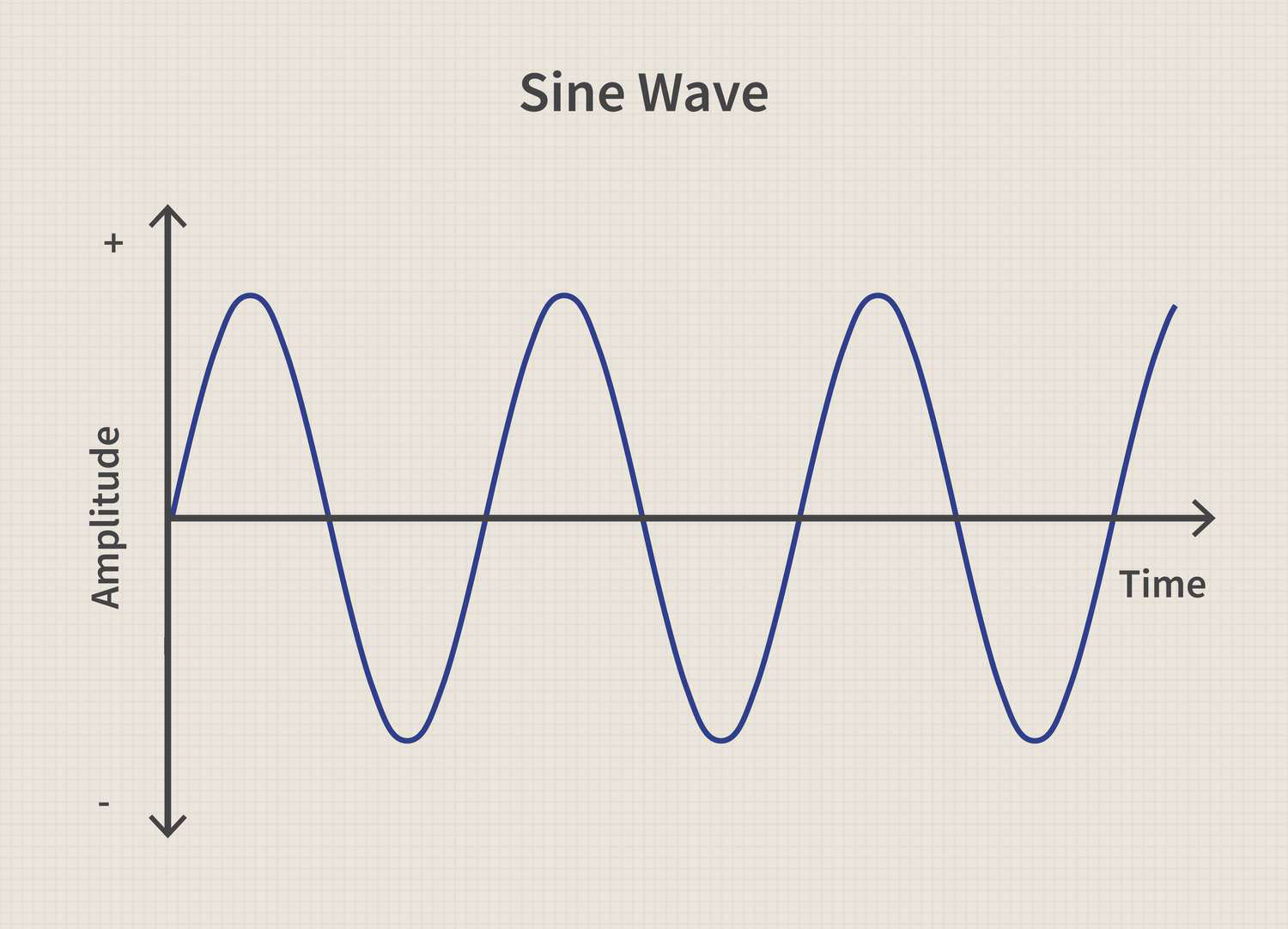
Everything, according to this vision, is pulsating with what he called the "wiggly" motion of life.
According to Watts, the basic Hindu model of the cosmos is that the Supreme Being engages in a process of acting out the entire
universe and everything in it, in an eternal
blissful play of creation, dissolution, and recreation, which he likened to the human cycles of dreaming and waking, inhalation and exhalation, apprehension and forgetfulness.
Everything, according to this vision, is pulsating with what he called the "wiggly" motion of life.
Watts showed the parallels between this cosmic cycle on the grand scale and the fundamental electromagnetic cycles of sound and light, the 0 and 1 of Binary Logic: the wave motion of all energy. In a stunning gesture of philosophical unification, he characterized it all as an eternal game of Hide and Seek that the Godhead plays with itself on all levels at once.
The traditional Sanskrit term for this divine play is Leela. We've briefly discussed it in Meanderings 8 but you can more fully appreciate it via the lucid and thorough exposition that Alan Watts gives in his 48-minute lecture entitled The Image of Man
But behind the scenes, in the green room - in the very back of your mind and the very depth of your soul - you always have a sneaking suspicion that you might not be the you that you think you are.”
 Interested in the horoscopes of other spiritual teachers ? See these articles:
 Interested in others who died of smoking, drinking, drug abuse ? See these articles:
 Want to learn more about Astrology ? See these authors: